Lie detector tests: how accurate are polygraphs, brain scans and AI?
What do lie detector tests measure? Compare polygraphs, P300, brain scans and AI, with research, error rates and a worked example of false accusations.
TL;DR
A lie detector result does not establish whether a whole account is true or whether someone committed a crime. Polygraphs measure physiological responses. Some brain-based tests examine responses associated with recognising information. AI systems classify patterns against labels supplied by researchers.
Some methods perform better than chance in controlled experiments. To interpret a result, you still need the task, the independent truth reference, the errors and the answers left undecided. A high score on one task does not settle a different one.
Passed what, exactly?
Someone in a documentary says they passed a lie detector. The sentence sounds like the end of an argument. But what questions were asked? Which procedure was used? Was the result a clear decision, or did the test leave something unresolved?
You need those details before deciding what the claim adds. “Passed” might describe a particular examination about a particular issue. It cannot silently expand into “everything this person says is true.”
That problem runs through lie detection: a response can be accurately recorded while the explanation attached to it remains uncertain. If you are following a case, the useful question is which factual claim the result helps to check, and what could still explain it another way.
The National Research Council’s 2003 assessment of polygraph evidence found that specific-incident tests could discriminate above chance in studied populations, while falling well short of perfection. It also warned against carrying those findings over to broad screening. The report is historical; it is a starting point for distinguishing uses, not a scorecard for every current product.
The last time we checked the research discussed here was October 19, 2026.
The sensors record a response, not a false sentence
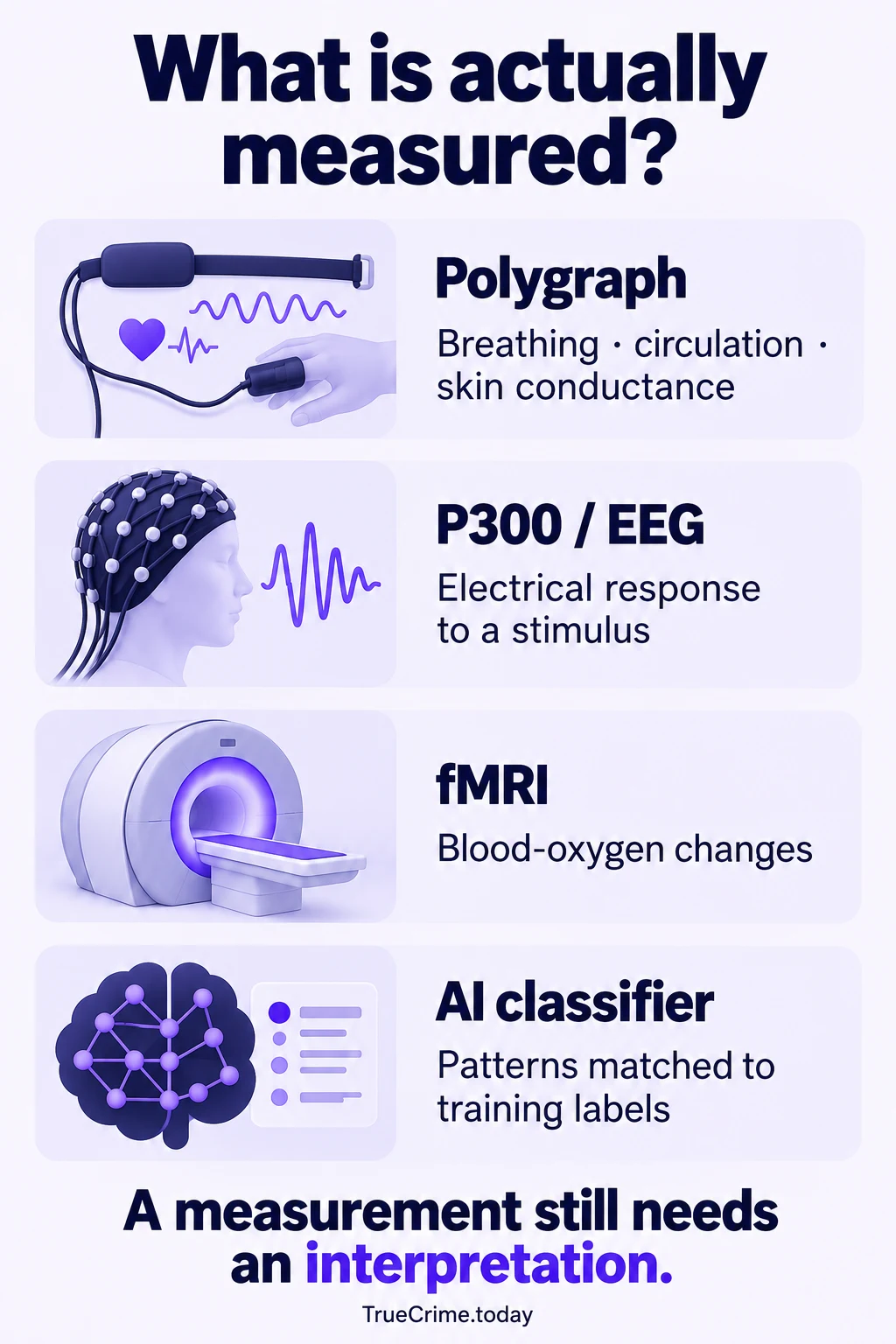
A conventional polygraph records several channels, including breathing, cardiovascular activity and skin conductance. The interpretation depends on how those responses differ across questions. None of these channels directly records a false proposition.
EEG records electrical activity at the scalp. The P300 is a component of an event-related response that researchers can examine after presenting a stimulus. Functional MRI measures blood-oxygen-related changes associated with activity, rather than recording a thought as a sentence.
AI may use transcripts, voice, video, physiological recordings or some combination. It learns or applies a rule for classifying inputs. The target label is part of the method, not a fact the computer obtains by looking harder at a face.
A 2025 evaluation of language and multimodal models tested courtroom material, instructed interpersonal deception and hotel reviews. Those are different tasks with different ways of deciding what counts as a truthful example. If you are judging a demonstration, you need that definition before the headline accuracy.
Why the question format changes the test
The Comparison Question Test, or CQT, compares reactions to relevant questions with reactions to comparison questions. Its interpretation relies on what those question categories elicit under the procedure. A sharp response to an accusation is not, by itself, the scoring rule.
The Concealed Information Test, or CIT, asks a different question: does a person respond differently to an item they may recognise among alternatives? The signal can concern recognition without identifying the reason for that knowledge.
This distinction also matters in case analysis. If you are checking whether someone knew a detail, keep that claim separate from whether they caused the event. A witness, an investigator and a person who saw a leaked photograph might all know something for different reasons.
A particular incident also differs from searching a large population for an unknown violation. The wording, prior information and frequency of the target behaviour change. You cannot assume the same errors simply because the equipment has the same name.
What the stronger polygraph results do show
There are positive findings to take seriously. The American Polygraph Association’s account of its 2011 review reports 38 included studies and 3,723 examinations, producing 11,737 scored results. The larger count reflects repeated scoring and methods, not that many independent people.
For event-specific diagnostic techniques, it reports about 89% decision accuracy and an 11% inconclusive rate. Those two figures belong together. A decision accuracy figure does not make the undecided examinations disappear, and it is not an 89% probability that a person in a documentary is honest.
Honts, Thurber and Handler’s 2021 CQT meta-analysis included 138 datasets and reached a more favourable view of accuracy and generalisation than prominent critics. Its reported effect size of 0.69 is not “69% correct.” Iacono and Ben-Shakhar’s 2019 review remained concerned about scientific foundations and the quality of field evidence.
These are disagreements about evidence and interpretation, not interchangeable estimates to average into one universal number. Positive associations deserve examination alongside how truth was confirmed, how cases were selected and whether the intended use matches the study.
The missing category: no decision
A system that can say “inconclusive” has an outcome beyond true and false. That may be appropriate when the record does not support a clear choice. But the category must stay visible in reporting.
Suppose difficult responses are set aside before accuracy is calculated. The remaining decisions can look better without the system becoming better at deciding every response presented to it. You need the proportion left unresolved and the rule that put them there.
A 2023 Russian heart-rate study by Uchaev and Apanovich illustrates the issue. Its two experiments used separate groups of 40 people. In the second task, the reported classification figure was 72.4% before an uncertainty region was introduced; it became 74.5% with 9.2% of responses left uncertain. These were response-level model results, not a guarantee for new people.
That is not an argument against an uncertainty category. It is an argument for reporting the denominator. Refusing to decide can be more honest than forcing a label; presenting the remaining accuracy as though every response received a reliable answer is misleading.
Strong detection rates can still produce mostly false alerts
Here is an original hypothetical calculation, not a measured result for any device. Imagine 10,000 people, of whom 100 know a protected detail. Assume a test has 95% sensitivity and 95% specificity and gives everyone a binary answer.
It flags 95 of the 100 knowledgeable people and misses five. Among the other 9,900 people, a 5% false-positive rate produces 495 false alerts and 9,405 correct negatives. There are 590 alerts, only 95 of them correct: 95 divided by 590, about 16.1%.
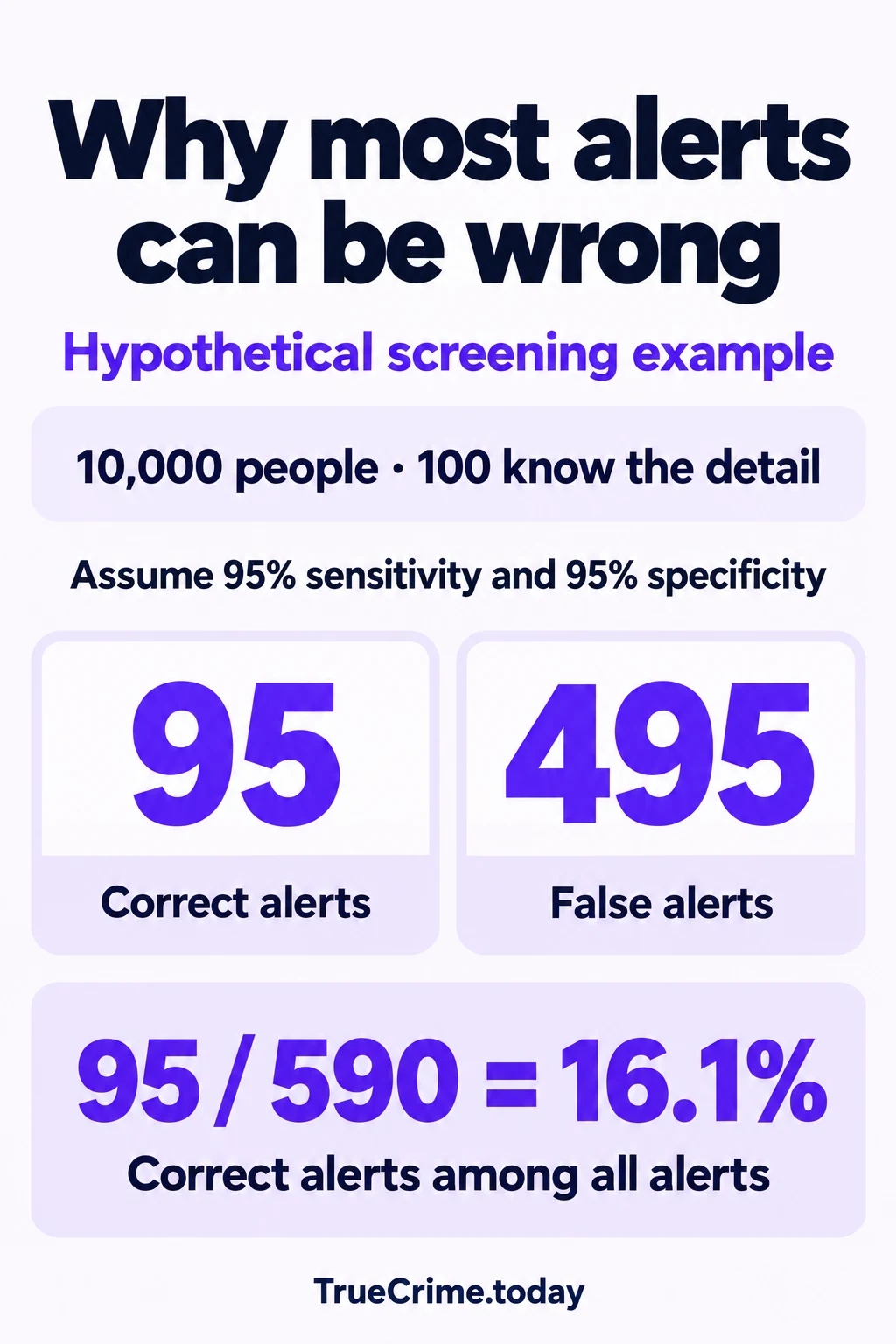
Sensitivity asks how often the target is detected when present. Specificity asks how often a non-target avoids being flagged. The question you care about after an alert, “how likely is this alert to be right?”, also depends on how common the target was before testing.
The calculation does not establish a real polygraph’s performance, and knowledge is not guilt. It shows why apparently strong component rates can be inadequate for a rare-event search. Real inconclusive outcomes would need their own count rather than being hidden inside this imagined yes-or-no test.
Knowing the hidden detail is not the same as committing the crime
A recognition test has a plausible advantage: it can ask about a detail that uninformed people should not distinguish from alternatives. But the value depends on keeping that detail genuinely informative.
If the detail has appeared in reporting or was mentioned during questioning, recognition has another explanation. A person might also fail to recognise something they once encountered. The test needs to distinguish a memory question from the conclusion being drawn about an action.
Meijer and colleagues’ 2014 meta-analysis found positive laboratory CIT effects across physiological measures. P300 had a larger average effect than skin conductance overall, but its advantage appeared in personal-item tasks, not in the mock-crime comparison. These are effect sizes, not percentages of criminals caught.
The task distinction matters. Recognising your own name and recognising a detail from a staged event are not interchangeable demonstrations. A useful result needs a defensible account of why the tested information was known and what its recognition can establish.
What P300 measures, and what the brain picture adds
P300 research compares responses to presented items under a defined protocol. A recognisable or meaningful stimulus can produce a different response from comparison items. That does not mean the equipment reads the content of a memory or identifies a dishonest intention directly.
Functional MRI adds another kind of measurement. A coloured map usually represents a statistical contrast in blood-oxygen-related signals under specified conditions. An area involved in attention, recognition or response control does not become a unique “lie centre.”
Moving from an average group difference to classifying a new person is another step. A finding can be useful for understanding a task without providing a dependable individual decision rule.
The research also asks whether deliberate strategies change performance. That matters when evaluating robustness. An article about reliability needs the resulting error evidence, rather than a set of instructions for manipulating an examination.
The experiment with a perfect selected subset
Langleben and colleagues’ 2016 controlled comparison involved 28 participants concealing a written number between three and eight. They underwent counterbalanced fMRI and polygraph sessions. Three experts for each method independently assessed the records without knowing the chosen number.
The reported relative risk of correct detection favoured the fMRI experts by a factor of 1.24. That is a relative comparison, not a 24-percentage-point accuracy advantage. The abstract also reports 100% combined accuracy in a selected set of 17 participants meeting an agreement condition across the two methods.
The selected set is not all 28. A perfect result after an agreement-based selection cannot be reported as a perfect general lie detector. It supports further testing of a combination and a rule for when it gives an answer.
The target also remained a concealed number. Recognising that result is compatible with finding the experiment promising. It does not require pretending that the same procedure has proved the truth of an unstructured account of a crime.
AI gets a label, not direct access to the truth
The 2025 ACL evaluation used 121 courtroom clips, 320 videos of instructed interpersonal deception and 1,600 hotel reviews. The differences in task were reflected in performance.
One few-shot GPT-4o configuration using balanced similar examples reported accuracy of about 79.6% on the courtroom dataset, 55.1% on the interpersonal dataset and 71.9% on the reviews. These are rounded values from that particular configuration, not current performance guarantees for the product.
Better performance on one benchmark does not settle whether the system can judge a new interview. The labels need scrutiny too. A case outcome does not independently verify every sentence spoken in court. A paid fabricated review and a genuine review can differ in how they were collected, as well as in honesty.
Evaluation should separate people as well as clips. If several recordings from one person appear in both development and testing, identity or recording context may provide a shortcut. A new-person claim requires a design that tests that claim.
Why a confident explanation can make the mistake worse
A model can produce an articulate reason for a false label. Mentioning hesitation, vagueness or strong emotion makes the output sound grounded, even when the same behaviour also occurs in truthful speech.
In the 2025 evaluation, generating explanations did not consistently improve performance. The error analysis included truthful uncertainty and speech disfluency being read as deception. A detailed explanation was not an independent confirmation of the classification.
This matters for public commentary. A doubtful label followed by a convincing paragraph can become a confident accusation when quoted elsewhere. The explanation should be checked against the record, including whether the claimed gesture, wording or pause is actually present.
Adding more inputs does not automatically fix the problem. Audio, video and text may add useful information, but they can also add shared biases, missing context or features unrelated to truth. The combined system needs its own evaluation.
A museum drawer, a photograph and a positive result
Imagine a fictional museum theft. A test suggests that a person recognises which drawer contained an object. Someone announces that only the thief could know that drawer.
Before accepting the conclusion, check the second claim. Was the drawer shown in a photograph? Did staff discuss it? Was the detail mentioned while the person was being questioned? These are possible sources of knowledge that do not require taking the object.
Now suppose a dated photograph shows the open drawer in a public visitor booklet. The recognition result might still be correct. The claim that recognition uniquely identifies the thief is what fails.
Conversely, a genuinely protected detail could make a recognition result more informative. It would still need to sit alongside the rest of the evidence about access, timing and actions. The useful question is which explanations the result can distinguish, including those that would clear the person.
What a useful test report needs to tell you
Start with the exact question and the outcome being predicted. Ask how truth, knowledge or deception was established independently of the test. A confession obtained after the result should not quietly become the only proof that the result was right.
Next, keep the full outcome count: correct detections, misses, false alerts, correct negatives and inconclusives. Ask whether the quoted accuracy concerns people, repeated responses, scored records or a selected subgroup.
For a new system, look for independent testing on new people under the proposed conditions. Language, recording quality, question format and the prevalence of the target all matter. So do prespecified thresholds and evidence about deliberate interference, rather than assurances that an examiner would always notice it.
Finally, distinguish scientific performance from usefulness in eliciting admissions and from legal permission to use a result. They require different evidence. Neither a documentary’s presentation nor a product demonstration settles all three.
What to keep when somebody says they passed
Treat the claim as the beginning of a question about a procedure, not a verdict on the whole person. Find out what was tested, what the result actually said and whether the underlying record is available.
A result may justify another factual check. It may be inconclusive, poorly matched to the claim or contradicted by stronger independent evidence. Be willing to revise the interpretation in either direction.
Polygraphs, brain-based tests and AI deserve neither automatic trust nor a dismissal that ignores positive findings. They deserve an account of what they measure, how they were tested and which errors remain. That is the information you need before allowing a technical result to carry an accusation.
You can ask about a polygraph result, a recognition experiment or an AI accuracy claim. Do not send private test records, recordings, passports, contracts, bank details or other personal documents.
Ask about lie detector research