True crime topics: choose what you want to understand
Browse true crime topics, from case evidence and criminal psychology to language, history, statistics and what to watch or hear. Choose where to start.

You might arrive at true crime topics with a case name, a question about an interview or just a free evening and a pair of headphones. Those are different starting points. Choose the question you want to follow, and you can spend more time on the part of the story that interests you.
The subjects here connect real cases with the ways people explain them: behaviour, words, records, historical context and numbers. You can also choose by format, whether you want a documentary, a book or something to listen to. The reading choices below lead into those subjects without requiring a course or a particular reading order.
TL;DR
For a particular story, start with cases. For a disputed explanation, choose psychology, deception research, language or statistics according to the claim. History and country guides help with context; the media guides help you find something to watch, hear or read. Pick one question and keep it with you as you read. You can change subjects whenever the story calls for it.
Start with the question, then choose the subject
“Why did this happen?” can mean several things. You may want the sequence of events, an account of someone’s behaviour or an explanation of why investigators accepted one version. Before choosing a subject, put that curiosity into a sentence you could ask a friend.
If the genre itself is unfamiliar, what true crime means is a useful starting point. Here, the choice is which part to read about next. A programme about an actual crime may raise questions about reporting, psychology and public discussion at the same time.
You do not have to pursue all of them. If you want a story for the evening, choose a format. If something in the story bothers you, choose the subject that can help you examine that particular point.
A crime count needs its own kind of reading
Suppose a video says a country has become more dangerous. One memorable case cannot tell you whether that claim describes a wider change. You need to know what was counted, where and during which period before comparing numbers.
In the United States, the Bureau of Justice Statistics distinguishes victim surveys from police-recorded crime data. Surveys can capture experiences that were never reported to police; police data describe crimes reported and recorded. The source matters before you draw a conclusion from the total.
That is a reason to choose the data subject rather than collect more dramatic examples. The same habit of asking what supports a sentence also helps when analysing a true crime case. You can enjoy a story and still pause over the claim that seems to carry its conclusion.
What a person said and why they acted are different questions
An interview clip can leave you wondering about a phrase, a facial expression or a possible motive. Each question needs a different kind of explanation. Start by naming what you actually noticed: a repeated word, an edit, a pause or a claim about someone’s personality.
Language analysis examines wording and the setting in which it was used. Deception research asks what proposed signs of lying can establish and how they were tested. Criminal psychology explores explanations of behaviour and the limits of applying a general theory to one person.
Keeping these subjects apart helps you avoid answering a question about words with a guess about character. A speaker’s phrase may be worth examining even when the clip gives you too little information to explain their intentions. The subject you choose should help you see what else you would need to know.
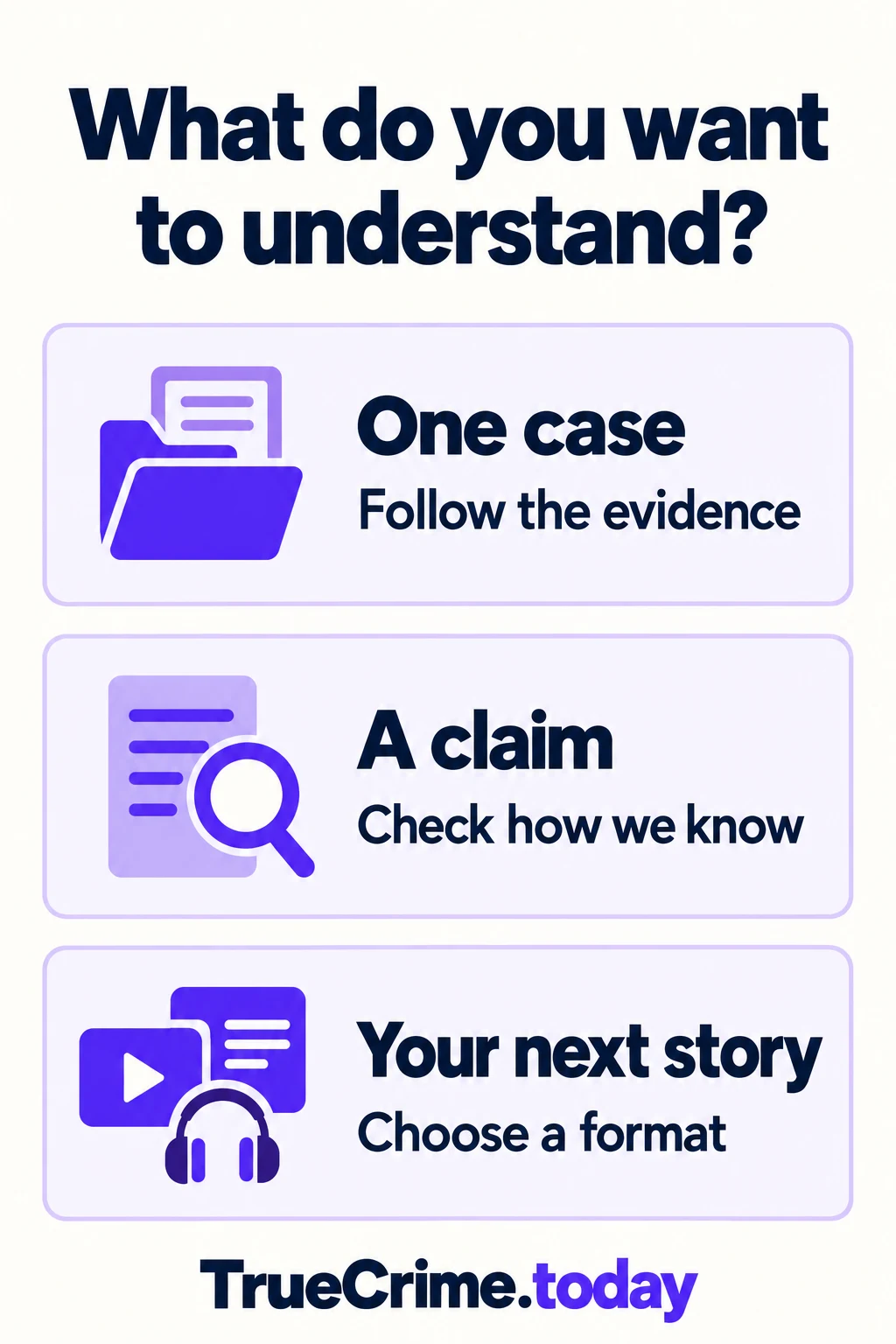
The diagram offers three ways into the collection. They can overlap: you might start with a podcast, follow its case and then want to understand a research claim. You can return to another subject when that question appears.
Follow one case before comparing several
A case account gives you people, events and a sequence to follow. Look for the date of the account and the point it reaches. An allegation, evidence presented at a hearing and a decision describe different parts of a story.
When a case has separate trial or verdict coverage, choose the part that answers your question. An overview may explain how the case developed, while a trial discussion can spend more time on what happened during the proceedings. A title containing “verdict” still needs a careful account of which decision is being discussed.
Comparing cases becomes more useful once you know what you are comparing. A shared location or similar headline does not by itself explain the same cause. Keep the evidence question narrow enough that you can see why a difference matters.
Put a place and a period around the story
Country guides help you find cases and understand the setting in which they are reported. A language edition does not change the location of a case. Keep the actual country and court in view when a story crosses languages or borders.
Historical reading adds another question: what material has survived? A contemporary account, a later recollection and a modern retelling may give you different access to the past. Dates and the origin of the material help you understand what the account can support.
Choose these subjects when context is the missing piece. You may already know the outline of a story and want to understand the institutions, reporting or period around it. Context can explain why a question was asked without settling the answer.
Choose something to watch, hear or read
You can browse by the experience you want. A long book, a self-contained episode and a series told over several parts ask for different amounts of time. The media guides help you identify the work, its format and the access offered.
If you have a title in mind, check the full name and version. A dramatization and a documentary about the same person can appear close together. A podcast feed can include trailers and extra interviews alongside the main story.
A familiar platform or presenter may help you choose what to try. To assess a particular claim, you will still want to know where it came from. Choosing entertainment and asking thoughtful questions can sit comfortably together.
Take one question into the next article
You do not need to turn every evening into research. Choose a question that interests you enough to follow: why a statement matters, how a number was counted or where a piece of footage came from. That gives the next subject a purpose.
As you read, distinguish what the material shows from the explanation offered for it. If an important point remains unclear, save the passage and the date. You can return to it without relying on an impression of the whole story.
When you move to another subject, keep that same question for a while. A different account may explain a term you missed or show why an apparent contradiction needs more context. More reading helps most when you know what you are trying to understand.
When a topic leaves you with more questions
Some explanations end with a genuine gap. The available material may not answer a question about intention, identify a speaker or support a comparison across countries. You can recognise that limit without giving up on the rest of the account.
You may also find a subject less interesting than expected. Choose another entry point. These topics are a way to browse, and the links below let you move between detailed cases, broader explanations and media choices.
In a discussion, keep a difference of interpretation attached to the material being discussed. Public questions do not require contacting people connected with a case or searching for their private information. A precise question about a public source gives other readers something they can consider too.
Before you choose
Do I need to read the subjects in order?
No. Start with your question or the kind of story you want today. If a subject introduces an unfamiliar term, follow that point when you need it rather than treating the whole collection as a required syllabus.
Where should I look for a particular case?
Start with cases, then choose the overview, trial or decision coverage that fits your question. Check the date and what stage the account covers before carrying its conclusion into a discussion about the present.
Send the public story link and the question you want to follow. Do not send private documents or personal details about people in a case.
Ask about a true crime topic